

Posted By Allison Logano on February 03, 2026
It’s one thing to spot emerging trends — it’s another to act on them.
This winter, we identified three forces reshaping finance, technology, and media for B2B brands. But beyond the headlines, what do these shifts actually mean for your business?
Preview: Our Winter 2026 Trends
Here’s what’s on our radar:
-
Finance: When it comes to money, Gen Z and younger consumers are abandoning safety and running straight into embracing risk — the massive boom of prediction markets being just one example.
-
Technology: After years of virtual-first innovation, the pendulum is swinging back to tech you can touch, from the return of landlines to hardware chips ready to power the next wave of AI.
-
Media & Marketing: More content is no longer the answer. Instead, shrinking media diets and algorithmic bottlenecking make intentionally the name of the game.
For a deeper dive, explore our free Winter 2026 Trends report.
So, what should B2B brands do next? Here’s how to turn these shifts into action in the year ahead:
1. Meet Customers in the Real World
Authentic, unfiltered, experiential — you’ve likely heard these buzzwords gaining momentum in the marketing world. We’re seeing that with AI, the analog era is only accelerating, as the need for a distinction between real world and digital becomes clearer. Search is also transforming, with algorithmic gatekeepers making authentic connection more valuable than ever.
Where you meet people and what you show them now makes all the difference. For 86% of Gen Z and Millennials, “touching and feeling products is essential to [their] purchase decisions.” Even B2B brands with more abstract offerings need physical proof points — if your product can’t be seen or felt, it must at least be experienced. Think live demos, touchable interfaces, immersive installations, and moments that invite buyers to take part in the process.
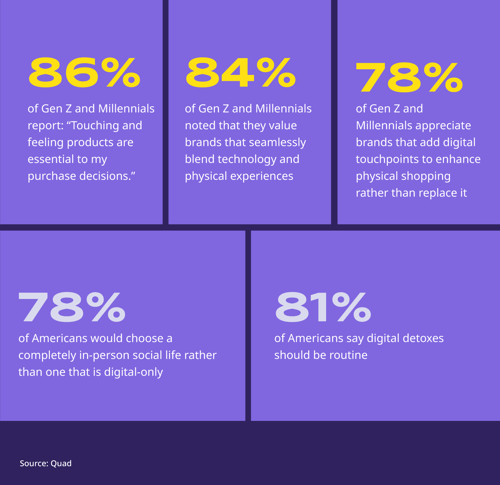
The most forward-thinking B2B brands are already leaning in. At this year’s Consumer Electronics Show (CES), the world’s biggest tech trade show, we saw booths that looked more like storefronts. They had interactive displays and hands-on demonstrations designed to pull people in — and keep them there.
2. Assume — and Embrace — Volatility
From money to tech to media, stability is no longer expected. Change is the new constant. As we explore in the report, this shift is closely tied to a broader comfort with risk — especially among younger people who have grown up inside instability rather than outside it. Whether it’s a crypto trading app updating by the second, an AI search result pulling in the latest data, or a media feed that reshuffles with every refresh, the expectation is responsiveness, not certainty.
In fact, we’re seeing the opposite resonate more: products that openly acknowledge flux and help users plan around it. B2B brand messaging should emphasize adaptability, scenario planning, and informed choice — not rigid optimization or fixed outcomes.
On the product side, this shows up as tools built for adjustment: live dashboards, flexible commitments, scenario toggles, and real-time alerts that invite users into the decision-making process. “Set it and forget it” is dead.
3. Make Humanity the Signal
In 2026, marketers will be speaking to two audiences: human and robot. We’re already seeing this split take shape as people grow more comfortable handing off discovery and decision-making to bots — allowing automated systems to filter information and serve up what matters most. At the same time, the tolerance for overreach is razor-thin. This dual reality makes both audiences essential, and fragile.
What’s interesting is that what ultimately resonates with both audiences is the same thing: human insight. Trust is becoming the true differentiator for B2B brands in a landscape increasingly mediated by machines. Bots prefer to cite content rooted in clear expertise and traceable sources. People, meanwhile, want to interact with ideas that feel authored — not generated.

That means credibility now depends on visible humanity. If you’re optimizing for machine trust, emphasize expertise and clearly denote (human!) authorship. Put human words in quotes if you have to. Let real employees speak to human audiences. Be willing to answer real — and sometimes uncomfortable — questions. Tell fewer stories, but make them unmistakably human.
Trends for Your Business
These trends come to life in our Winter 2026 Trends Report, where we unpack what’s changing for B2B — and why it matters now. Explore the full report to understand what these shifts mean for your business.